You decided on hardwood floors? Great! Now let’s move to the question that stumps Greater Seattle homeowners: solid or engineered hardwood?
Both are real hardwood. Both are beautiful. However, depending on your home’s subfloor, moisture conditions and where you’re installing, one will serve you better than the other. At Nielsen Brothers Flooring, we’ve been helping Lynnwood, Edmonds and homeowners throughout the Greater Seattle area make this call for generations. Let’s get into how we think about it.
What is Solid Hardwood?
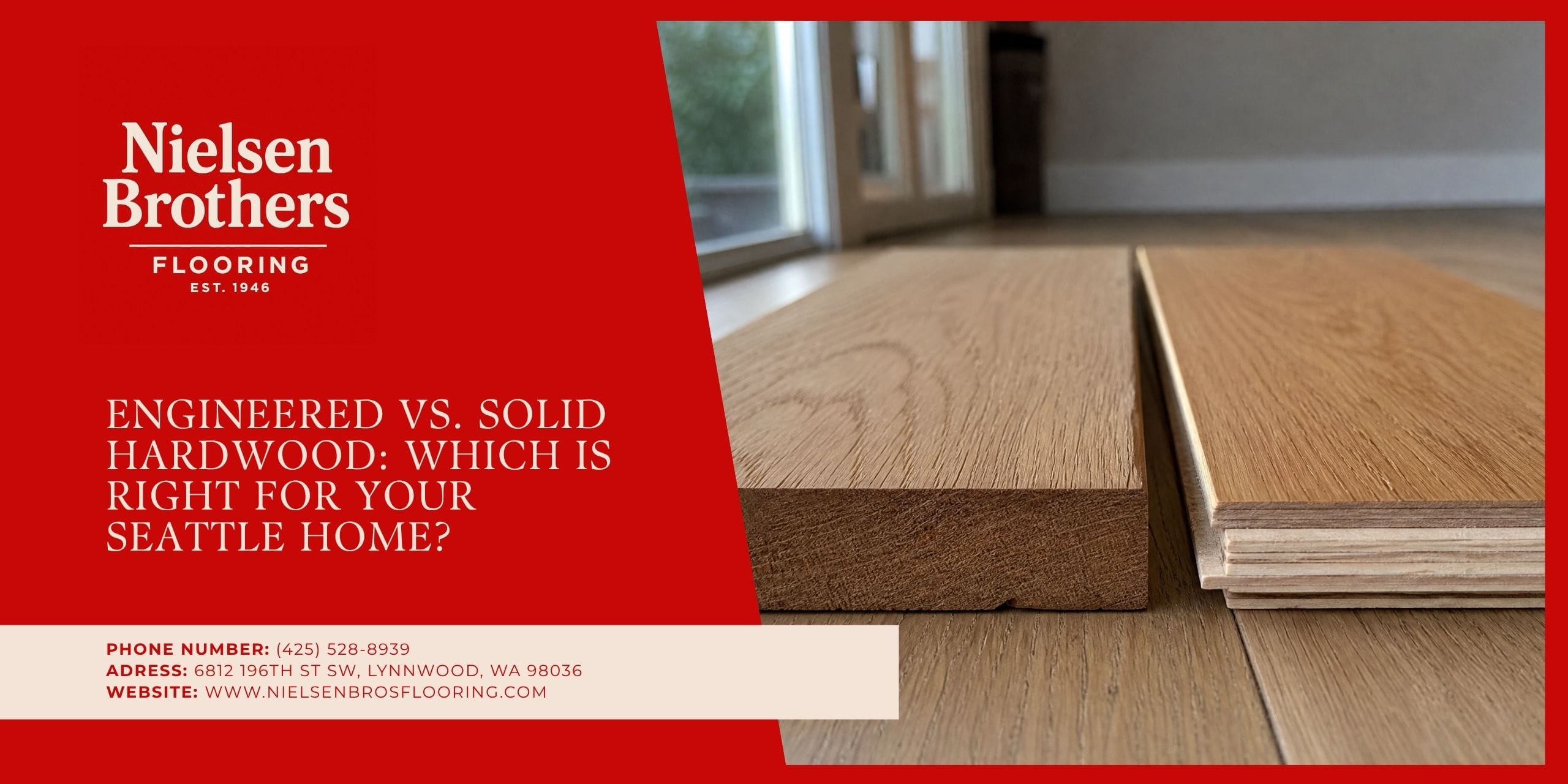
Solid hardwood is a plank of real wood milled from a single piece of timber. Popular species include oak, maple, hickory, Brazilian cherry and more. Planks are usually ¾ inch thick.
Since the entire plank is wood, you can sand and refinish it multiple times over its lifetime. A well-maintained solid hardwood floor installed today can remain in your home 50, 75 or even 100 years from now. It can be sanded and refinished as many times as the thickness allows, making it one of the most enduring flooring investments available.
All that said, this option is more sensitive to the environment. Real wood expands and contracts with changes in humidity and temperature. The natural movement is manageable with proper installation, but solid hardwood has limits on where it can go and what subfloor conditions it can tolerate.
What is Engineered Hardwood?
Engineered hardwood is real wood, but built differently. A thin veneer of real hardwood sits on top of multiple layers of plywood bonded together in alternating grain directions. The cross-ply construction gives it dimensional stability.
The end result is a floor that looks and feels like solid hardwood from the surface, but isn’t as reactive to humidity and subfloor conditions. Engineered hardwood can be installed in places where solid hardwood can’t be, such as on or below grade over concrete subfloors and in rooms with variable moisture levels.
The veneer layer is generally sanded and refinished, but fewer times than solid hardwood. Thicker veneer layers allow for more refinishing passes, but it’s worth asking about veneer thickness when choosing a product.
What are the Key Differences for Pacific Northwest Homeowners?
When you live in the Pacific Northwest, hardwood reacts differently. Here are factors to consider before making a decision:
Moisture and Humidity Stability
When you own a home in Greater Seattle, Edmonds or the surrounding area, you know this all too well.
The Pacific Northwest is rich with moisture. Seasonal humidity swings, older subfloors that have absorbed decades of moisture and the Gypcrete subfloors common in Edmonds condos create difficult conditions for solid hardwood.
Gypcrete floors are moving and so are the buildings. Because of this, many jobs need leveling. As a result, solid hardwood isn’t usually the right call.
Engineered hardwood has a layered plywood core that withstands expansion and contraction that’s common with solid hardwood. That makes it a better choice for Pacific Northwest homes with varying humidity levels, especially in condos, older homes near the water and rooms where moisture is difficult to control.
Subfloor Requirements
Solid hardwood must be nailed or stapled to a wood subfloor. Installing over concrete is not recommended below grade. If your home has a concrete slab, Gypcrete floor or you’re planning a basement installation, solid hardwood is out of the question.
Engineered hardwood flooring is more versatile. Options include nail-down, staple-down, glue-down or a floating floor. Glue-down engineered hardwood is common across Greater Seattle. The process includes a whole new set of skills and prep steps that didn’t exist back when Nielsen Brothers was only installing carpet and solid hardwood.
Subfloor prep matters regardless of the product. Leveling, moisture mitigation and proper priming determine how long your floor will last and if a warranty claim will be honored if something goes wrong.
Refinishing Potential
Solid hardwood can be refinished several times. Because the full plank is wood, it can be sanded down five to eight times over a floor’s lifetime, returning it to like-new condition and allowing for color changes.
Engineered hardwood can be refinished, but only a limited number of times if at all. It depends on the veneer thickness. Entry-level products may withstand one or two light sandings while higher-quality products can take three or four. While less than solid, you can still extend the lifespan of your floors.
Does long-term refinishability come first? Look into the thickness of the engineered product. It separates a long-lasting floor from one that looks good at first, but can’t be renewed.
Installation Considerations
Both products require proper hardwood installation by experienced Lynnwood flooring contractors without shortcuts.
Solid hardwood needs time to acclimate to your home’s humidity and temperature before installation day. Plus, proper perimeter clearances are needed to allow for natural movement. The crew understanding how the floor behaves seasonally leaves room to do so without gapping or buckling.
Engineered hardwood, more specifically, glue-down installations have their own set of preparation requirements:
- The right adhesive for the product and subfloor
- Proper trowel spread
- Adequate open time
- A thorough understanding of moisture readings
It’s one of the more technical challenges for today’s flooring experts. However, they have been able to adapt with proper training.
So Which Should You Choose?
How do you come to a decision? Here’s what you need to know about each option:
Choose solid hardwood if:
- You’re installing on a wood subfloor above grade
- Long-term refinishability and maximum longevity are priorities
- The room has controlled, consistent humidity levels
- You’re investing in a home you plan to own for decades and the most authentic hardwood experience
Choose engineered hardwood if:
- You’re installing on or below grade or over a concrete or a Gypcrete subfloor
- Your home is in an older building or near the water where humidity varies seasonally
- You want the look and feel of real hardwood in a space where solid hardwood isn’t recommended
- You’re in a condo, engineered hardwood is almost always the right call
What if you still can’t decide? Consult a professional. That’s the best way to choose a floor that works for your home’s conditions, not just the one you fall in love with in the showroom.
What is the Nielsen Brothers Perspective?
Growing up in the business, our owner, Mike Nielsen saw a shift in the industry. From installing carpet and solid hardwood to everything in between, we’ve been there. Nielsen Brothers Flooring has evolved with these changes. When it comes down to solid and engineered hardwood, an in-home consultation is the best way to make the right choice for your Pacific Northwest home.
Ready to find the right hardwood for your home? Contact us to schedule a free in-home consultation with Mike today!