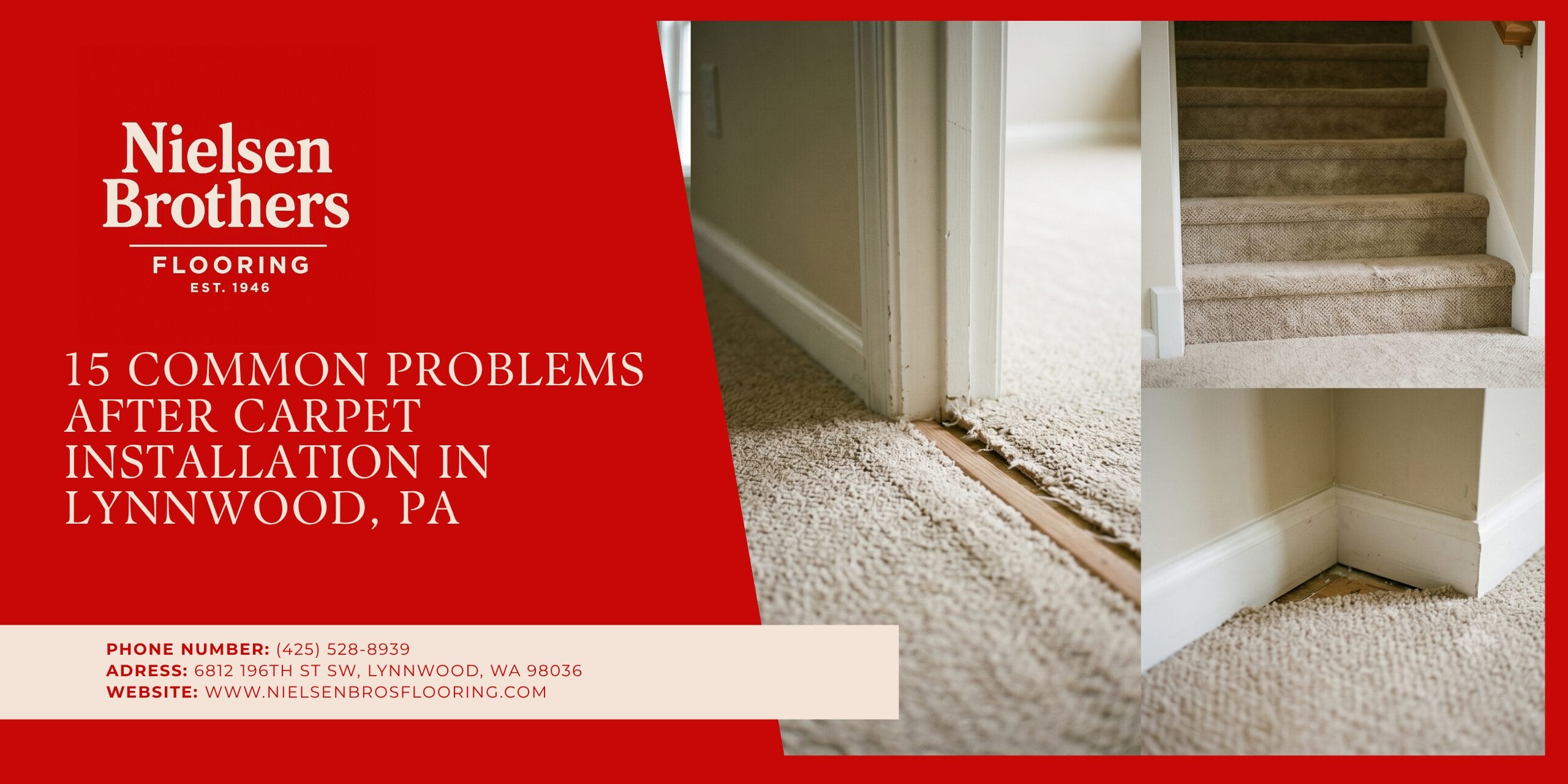
The 12 most common problems we see after carpet installation in Lynnwood homes are ripples and waves in walkways, visible seams that should be invisible, carpet pulling away from walls, matting and crushing in high traffic areas, persistent shedding beyond the first few weeks, color variation between sections, transition strip issues, stains resisting normal cleaning, allergic reactions or odors, floor squeaks emerging through new carpet, padding showing through the surface, and carpet not matching the showroom sample appearance. Most of these problems are preventable through careful carpet installer selection and proper installation technique, and most are addressable through restretching, repair, or warranty claims when they do develop. The patterns that produce these problems are predictable enough that knowing what to watch for during installer selection prevents most of them from happening in the first place.
| Problem | Typical Timing | Most Common Cause |
| Ripples in walkways | First 6 to 12 months | Inadequate stretching during installation |
| Visible seams | Immediate or first few weeks | Poor seam construction or placement |
| Edges pulling from walls | First 3 to 12 months | Stretching or tack strip placement |
| Matting in high traffic | First 6 months | Wrong padding or carpet construction |
| Excessive shedding | Beyond 12 weeks | Manufacturing or construction issue |
| Color variation | Visible immediately | Dye lot or pile direction issues |
| Transition problems | Visible immediately | Strip selection or installation |
| Stain resistance failure | First spill onward | Product defect or contamination |
| Odor or allergy issues | First 2 to 3 weeks | Product VOCs or contamination |
| Floor squeaks | Walking immediately | Subfloor not addressed before install |
| Padding showing through | Visible within weeks | Padding installation errors |
| Sample mismatch | Visible immediately | Lighting, scale, or production variation |
Key Takeaways
- Most post installation problems trace to installation shortcuts rather than product defects.
- Inadequate stretching causes the largest category of problems we see called back about.
- Many issues are preventable through careful installer selection and verification of installation methods.
- Catch problems early. Issues addressed in the first months are usually cheaper to fix than the same problems left for years.
- Document your installation with photos and keep all paperwork for warranty purposes.
- Distinguish installation issues from product issues. Different warranties apply to each category.
- Quality carpet installation services treat post installation problems as part of their job, not as inconvenient afterthoughts.
Why We Wrote This Guide
We have been helping clients purchase new carpets in Lynnwood, PA and handling carpet installation projects across Lynnwood,PA and the surrounding Snohomish County area for over 80 years and we have seen the same set of problems come up repeatedly. Some of these problems come from previous installations that customers ask us to fix or assess. Others come from new installations where something did not go right. The patterns are consistent enough that we can predict which problems will develop in which situations, and that pattern recognition is exactly what we want to share with homeowners considering carpet installation projects.
Our motivation in writing this guide is not to scare anyone away from carpet installation. The opposite is true. Most carpet installations go well and produce results that homeowners are happy with for years. The problems described in this article are common enough to be worth understanding but not common enough to dominate the experience of carpet installation overall. The difference between projects that go well and projects that develop problems comes down to a handful of factors that homeowners can evaluate during the installer selection process.
Honesty matters here. We have seen all of these problems in our own work occasionally, even with the best processes. Carpet installation is craft work performed by humans, and craft work occasionally produces results that need correction. The difference between operations that handle problems well and operations that produce them more often comes down to commitment to standards, willingness to address issues when they arise, and the experience to prevent the predictable categories of problems before they happen. We share that perspective so homeowners can evaluate any carpet installer they consider, including us, with realistic expectations rather than marketing language.
The 12 Most Common Problems We See
Each problem below describes what the homeowner experiences, what typically causes it, what can be done about it after the fact, and how to prevent it during installer selection or new installation. The depth varies because some problems need more discussion than others. The longer entries are not more important, just more nuanced in their causes and resolution.
1. Ripples and waves developing in walkways
This is the single most common post installation problem we see called back about, and the underlying cause is almost always inadequate stretching during the original installation. Carpet that is not properly tensioned across the room develops slack over time as foot traffic shifts the fibers and the backing relaxes. The slack accumulates in walkway patterns where traffic concentrates, eventually becoming visible as ripples or waves running across the room.
We see this problem most often when customers tell us their previous installation was done quickly or by crews that did not use a power stretcher. Knee kicker only installations consistently produce ripples within the first year because knee kickers cannot generate the tension needed across spans larger than a few feet. The proper installation method uses both a power stretcher for the main tensioning and a knee kicker for finishing details, and skipping the power stretcher is the most common shortcut that produces this specific problem.
If ripples have developed in your existing carpet, the fix is restretching by carpet installers with proper equipment. This involves pulling the carpet back at one wall, restretching it across the room with a power stretcher, and securing it again at the tack strips. The carpet itself can be reused if the ripples have not progressed to permanent damage of the fibers. Restretching extends the useful life of the carpet substantially when the underlying product is still in good condition.
Prevention during new carpet installation comes down to choosing carpet installers who use power stretchers as standard practice and who take time to do the work correctly. Ask specifically about their stretching equipment and technique before hiring anyone for residential carpet installation. Crews that hesitate or get defensive about the question are signaling something worth taking seriously.
2. Visible seams that should have been invisible
Properly executed seams in quality carpet should be essentially invisible in the finished installation. When seams remain visible, the cause is usually either poor seam construction technique, inadequate planning during measurement, or carpet selection that makes seams hard to hide regardless of installation quality. Each cause has different implications for what can be done about it now.
Poor seam construction shows up as visible bumps where the carpet edges did not align flat, gaps that open over time as the carpet shifts under traffic, fiber discoloration along the heat line from improperly used seaming irons, or fraying at the seam edges from imprecise cutting. These are workmanship issues that good carpet installers prevent through proper technique. They are difficult to repair without recutting the seam, which is expensive and not always possible depending on remaining carpet supply.
Inadequate seam planning during measurement places seams in high traffic walkways, perpendicular to incoming light in ways that highlight them, or in doorways where wear concentrates. These planning errors cannot be fixed without reinstalling sections of carpet, but they can be prevented during new installation through deliberate seam placement decisions made during measurement. Our team plans seam placement during the measurement appointment rather than handling it as an installation day decision specifically because this is when the choices matter.
3. Carpet pulling away from walls and tack strips
Carpet that pulls away from walls or lifts off tack strips is usually a stretching problem, but it can also indicate tack strip placement errors during the original installation. The visible symptoms are similar regardless of underlying cause, but the fix differs based on what actually went wrong.
Stretching related edge problems occur when the carpet was not pulled tight enough during installation, leaving slack that eventually allows the edges to release from the tack strip pins. This is closely related to the rippling problem but manifests at the edges rather than in the field of the carpet. The fix is restretching and reattaching to the tack strips. The same approach that handles rippling addresses edge release.
Tack strip placement problems occur when tack strips were installed at the wrong distance from the wall during the original installation. Tack strips need to sit about two thirds of the carpet pile thickness away from the wall, with the pins angled toward the wall. Strips placed too close to the wall make it impossible to properly tuck the carpet edge. Strips placed too far from the wall leave a visible gap when the carpet is stretched into position. Both errors require removing and reinstalling the tack strips before the carpet can be properly secured.
Edge problems are also sometimes caused by humidity changes that affect carpet dimensions, particularly in homes with large variations between summer and winter conditions. Pacific Northwest humidity is more stable than some climates, but we still see edge changes through seasonal cycles in Lynnwood homes. Quality installation with proper stretching accommodates normal seasonal variation. Marginal installations show edge problems as soon as the first humidity cycle stresses the installation.
4. Matting and crushing in high traffic areas
Some matting and pile compression is normal as carpet ages. Concerning matting develops within months of installation rather than over years, and it indicates either inappropriate carpet selection for the traffic conditions, inadequate padding underneath, or a product quality issue with the specific carpet purchased. Distinguishing between these causes determines whether the problem is recoverable or requires replacement.
Pile crushing in high traffic areas often traces back to padding selection. Padding that is too soft allows the carpet to compress excessively under foot traffic, with the matting appearing as visible walkway patterns. The padding cannot recover quickly enough between traffic events, so the compression becomes more or less permanent. Replacing the padding with appropriate density and thickness for the carpet construction can resolve this problem if caught early enough. Heavier traffic patterns benefit from denser padding specifications than light residential use requires.
Carpet construction also matters for matting resistance. Lower density carpet with sparse fiber tufts mats faster than higher density construction. Berber loop pile resists matting better than cut pile in some applications but shows snags more easily. Frieze and twist constructions have inherent resilience that resists matting under normal residential traffic. Matching carpet construction to actual use patterns is part of what we discuss during consultations before installation rather than after problems develop.
5. Shedding that does not stop after the first few weeks
New carpet sheds during the first several weeks after installation, which is normal and expected. The shedding comes from short fibers left in the carpet from manufacturing that work loose during the first weeks of vacuuming and traffic. This shedding should diminish substantially within 4 to 6 weeks and stop almost entirely by 8 to 12 weeks.
Shedding that continues at full volume beyond 12 weeks is not normal and indicates either a manufacturing defect with the specific carpet or a construction characteristic that the customer was not informed about during purchase. Some carpet constructions shed more than others by design. Wool carpets shed more than synthetic. Cut pile sheds more than loop pile. Premium carpets generally shed less than budget products. Customers who understood these characteristics during selection are less likely to consider continued shedding a problem.
When shedding persists beyond reasonable timeframes and was not disclosed as a product characteristic, the issue becomes a warranty consideration with the carpet manufacturer rather than an installation problem. Quality carpet installation services handle warranty claims with the manufacturer on behalf of the customer, which is one reason buying carpet and installation through a single source produces better outcomes than separating these purchases. The flooring company that sold the carpet has standing to pursue manufacturer warranty claims that individual homeowners often cannot resolve on their own.
6. Color variation between sections or rolls
Carpet color variation between sections is one of the more frustrating post installation problems because the issue is genuinely difficult to detect during installation but becomes obvious once the customer lives with the installation in regular lighting conditions. The variation can come from several sources, each with different implications for resolution.
Dye lot variation occurs when carpet from different production runs gets installed in the same project. Carpet manufacturing uses batches of dye, and slight variations between batches are normal and largely invisible when carpet is examined individually. When carpet from different dye lots gets installed next to each other in the same room, the variation can become visible especially in certain light conditions. Quality installation specifies single dye lot material for the entire project to avoid this problem, which is one of the details careful Lynnwood flooring contractors attend to during ordering rather than installation.
Pile direction variation creates apparent color differences even when the carpet itself is identical. Carpet pile reflects light differently depending on direction, which means sections installed with piles running in different directions can appear as different colors. This is why proper installation pays attention to pile direction across the entire room, with all pieces installed running the same way. Pile direction errors are particularly visible in solid color carpets where there is no pattern to mask the variation.
When color variation appears after installation and the problem is dye lot related, the only complete fix is replacement of one section with material that matches the other. This is expensive and frustrating, and it is why we put significant effort into single dye lot ordering during the original installation. When variation is pile direction related, restretching with corrected direction can sometimes resolve the problem without material replacement, though this is more complex than simple restretching and requires careful planning.
7. Transition strips that look wrong or are coming loose
Transition strips do more work than most homeowners realize. They hide the cut edge of the carpet, secure the carpet to the floor at transition points, accommodate the height difference between different flooring types, and visually finish the boundary between rooms. When transitions are done poorly, the problems become daily visible annoyances that the homeowner notices every time they walk through the affected area.
Common transition problems include strips that have lifted from the floor and become trip hazards, strips that look obviously cheap compared to the rest of the installation, strips that do not actually cover the carpet edge cleanly, and height transitions that produce uneven walking surfaces. Each problem has specific causes during installation that quality work prevents.
Transition strip selection happens during the measurement and consultation phase rather than during installation. The transition style needs to match both the carpet selection and the adjacent flooring, with consideration for the height difference and the visual style of the home. Default builder grade transitions look cheap in many residential installations and are worth upgrading during planning. Our team discusses transition options during measurement specifically because the decisions made then determine how the finished installation reads visually, and changing transitions after installation is more expensive than choosing well from the start.
8. Stains appearing that resist normal cleaning
Carpet stains are part of life with any residential carpet installation, but stains that resist normal cleaning sometimes indicate either a product defect, an installation issue, or contamination present during installation. The pattern of when stains appear and how they behave when cleaned helps identify which underlying cause is involved.
Stains that appear in a regular pattern across the carpet, particularly in rectangular patterns matching the carpet roll layout, sometimes indicate manufacturing defects in stain resistance treatment. Modern residential carpets typically include factory applied stain resistance, and inconsistent application produces visible variation in how the carpet responds to spills. This is a manufacturer warranty issue that requires documentation and claim filing with appropriate evidence.
Wicking stains appear when spills that seemed cleaned up reemerge as the carpet dries. The cause is moisture that penetrated the carpet backing or padding, carrying staining material with it. As the moisture wicks back up during drying, the staining material comes with it and reappears at the surface. The fix involves treating the affected area more aggressively to extract the moisture and staining material from the backing and padding, which is more involved than surface spot cleaning. Persistent wicking stains sometimes require professional cleaning service to fully resolve.
Contamination present during carpet installation is a less common but real cause of stain problems. Adhesive residue from previous installations not fully removed during prep work, wood stain or paint on the subfloor that bled through, or chemical contamination from previous spills can produce stains that emerge through new carpet. Proper subfloor preparation prevents this category of problem, and inadequate prep work is one of the shortcut areas where installation quality varies significantly across different carpet installation services.
9. Allergic reactions or strong odors after installation
New carpet typically has a noticeable odor for the first 24 to 72 hours after installation, which dissipates as the volatile organic compounds in the adhesives and treatments off gas into the environment. Persistent odors beyond the first week, or symptoms that develop in family members and persist, indicate problems worth taking seriously rather than dismissing as adjustment period concerns.
Quality carpet products from established manufacturers meet specific emissions standards that limit the VOCs released after installation. Products marked with the CRI Green Label Plus certification have been tested for low emissions and produce significantly less off gassing than uncertified products. For households with sensitive family members, asthma sufferers, or environmental sensitivity concerns, choosing certified low emission products is the right approach during selection rather than addressing problems after installation.
If odors persist or symptoms develop, ventilation can help in the short term. Open windows, run fans, and increase air circulation to accelerate the off gassing process. Persistent issues beyond 2 to 3 weeks warrant conversation with the carpet installer or retailer who handled the project. Manufacturing defects in stain resistance treatments, contamination during transport or storage, or product issues that the retailer was not aware of can all produce ongoing problems that need professional resolution rather than waiting for them to resolve themselves.
10. Squeaks emerging or worsening after installation
Floor squeaks have nothing to do with the carpet itself but everything to do with how the installation handled the subfloor underneath. New carpet that reveals squeaks not previously noticed, or that seems to amplify existing squeaks, indicates that subfloor preparation skipped the squeak addressing step that should have been part of the installation process.
Quality residential carpet installation includes subfloor inspection after the existing flooring is removed and before new flooring goes down. Squeaks become apparent during this inspection because the subfloor is exposed and can be walked across directly. Addressing squeaks involves re-securing the subfloor sheathing to the floor joists with screws driven through the existing nails. This step takes 10 to 30 minutes per room but produces dramatic improvement in floor quietness for the life of the new flooring.
Squeaks emerging after installation are difficult to fix without removing the carpet to access the subfloor, which is why we make squeak inspection part of every project rather than treating it as an optional add on. The marginal time spent on squeak fixing during installation is essentially free compared to the cost of addressing squeaks after the new carpet is in place and the subfloor is no longer accessible.
11. Padding bunching or showing through the carpet
Padding problems show up as visible lumps in the finished carpet, padding edges that telegraph through the carpet surface, or distinct ridge lines where padding seams underneath the carpet have shifted or curled. The visible carpet shows the underlying problem because nothing can hide irregularities in the padding from the finished surface.
The most common cause is inadequate padding installation rather than padding product issues. Padding seams should be taped together with appropriate padding tape, and padding pieces should fit flat without overlap or gaps. Padding that overlaps at seams produces ridge lines. Padding that gaps at seams produces depressions. Padding that curls at edges or has been damaged during installation produces visible irregularities once the carpet goes down on top.
Resolving padding problems after installation requires removing the carpet from at least the affected section, fixing or replacing the problem padding, and reinstalling the carpet. This is expensive enough that catching padding problems during installation rather than after is dramatically preferable. Quality carpet installers check padding flatness and seam quality before laying carpet over it precisely because the difference between proper and improper padding installation is invisible to the customer but determines the long term appearance of the finished installation.
12. Carpet that simply does not look like the showroom sample
This is one of the most disappointing post installation problems because it usually emerges only after the installation is complete and the customer lives with the result in actual home conditions. The installed carpet looks different from the sample selected at the showroom, often noticeably so. Several factors contribute to this experience, and understanding them helps both with prevention during selection and with managing expectations realistically.
Lighting is the largest factor in apparent color differences. Showroom lighting is typically uniform fluorescent or LED lighting designed for retail display. Home lighting includes natural light from various window orientations, evening artificial lighting from different fixtures, and the interaction of light with wall colors and furnishings that do not exist in the showroom. The same carpet genuinely looks different in different lighting conditions, and the showroom version is rarely a perfect predictor of the home result. Taking samples home for evaluation in actual lighting before committing to selection prevents the worst version of this problem.
Scale also affects perception. A small sample at the showroom shows color and pattern at a scale that does not match how the installed carpet appears across an entire room. Patterns that seem subtle on a 12 inch sample can become dominant when installed across 200 square feet. Colors that seem neutral on a small sample can appear stronger or weaker at room scale. Walking on installed samples in showroom displays helps bridge this gap, which is why our showroom maintains installed displays in addition to sample boards.
Different production runs of the same product can also have subtle variations that show up only at installation scale. This is normal for carpet manufacturing and falls within acceptable tolerances for the industry, but the customer experience of the variation can still be disappointing. Selecting from current inventory rather than samples that may be years old reduces this risk. Nielsen Brothers Flooring works to ensure customers see current production samples during selection so the installed result matches expectations as closely as possible.
Lynnwood Specific Considerations
Most of the problems described above happen in any carpet installation regardless of location. A few factors specific to Lynnwood and the broader Pacific Northwest affect how some of these problems develop or are best prevented.
Humidity in this region is generally more stable than in extreme climates like the upper Midwest or desert Southwest, which means carpet installations face less seasonal dimensional stress. This works in favor of installations done well and against installations done poorly. Marginal installations that might survive in stable climates show problems quickly here because the moderate humidity provides no margin for shortcuts. Wet winters with extended periods of moisture exposure compound the impact of any installation that mishandles moisture management at transitions and entries.
Older Lynnwood homes built before 1980 often have subfloor and structural conditions that newer construction does not present. Original subfloors may have settled unevenly, creating high and low spots that require leveling before new carpet can be installed properly. Existing squeaks in older homes are common and need to be addressed during the demolition phase before new flooring goes down. Newer homes in the suburban developments around Lynnwood typically have engineered subfloors that handle most carpet products well, with fewer subfloor surprises during installation.
Pacific Northwest indoor air quality concerns affect product selection more than installation directly. Some Lynnwood homeowners with allergies or environmental sensitivity benefit specifically from low VOC carpet products with appropriate certifications. The product selection during purchase affects the post installation experience substantially for these customers, which is why our consultation process includes specific discussion of household sensitivities when relevant.
Pet considerations come up frequently in Lynnwood carpet installation projects. The area has high pet ownership, and pet related problems including odors, stains, and physical damage from claws affect carpet performance significantly. Product selection should account for pet considerations during purchase rather than discovering pet incompatibility after installation. Some carpet constructions handle pet households dramatically better than others, and the difference matters for long term satisfaction.
How to Avoid These Problems on Your Next Installation
Most of the problems we discussed above are preventable. The prevention comes down to choices made during installer selection and the installation process itself. Specific actions homeowners can take produce dramatic improvement in outcomes compared to defaulting to whoever offers the lowest price.
Verify installation methods before hiring
Ask specifically how the installer handles stretching, seaming, subfloor preparation, and tack strip placement. The answers should be specific and confident rather than vague. Installers who use power stretchers as standard equipment will say so directly. Installers who skip this critical step often deflect or change the subject when asked. The questions take 5 minutes to ask and reveal substantial information about which installer will produce a quality result.
Get warranty terms documented in writing
Both labor warranty and manufacturer warranty should be in writing before any work begins. Labor warranties of 1 year are minimum acceptable. 2 to 5 year labor warranties indicate stronger commitment to workmanship. Lifetime workmanship warranties for major installation defects indicate the strongest commitment. Verbal warranty promises become essentially unenforceable when problems develop a year later, which is exactly when warranty protection matters most.
Document the installation thoroughly
Photograph the carpet after installation from multiple angles in good lighting. Keep the contract, warranty documentation, and product information organized in one place. These records establish the baseline appearance and the contractual terms that protect you if problems develop later. The documentation takes 15 minutes to create and produces protection that matters for years.
Address problems early rather than waiting
Problems caught in the first months are usually cheaper to fix than the same problems left for years. Ripples that have just begun developing can often be restretched easily. Ripples that have continued worsening for two years sometimes require partial replacement. The same logic applies to most of the issues in this article. Early reporting to the installer also keeps warranty coverage active during the time when it matters most.
Choose products appropriate for actual use
Carpet selection that does not match actual household use produces problems that no installation quality can prevent. Active pet households need pet appropriate constructions. High traffic homes need higher density and more resilient products. Allergy concerns need low VOC certified products. The product selection during purchase often matters as much as installation quality for the long term experience of the carpet.
When Problems Develop, What to Do
Despite best efforts at prevention, problems sometimes develop with carpet installations. When they do, a clear process helps resolve them efficiently rather than letting them fester into larger issues.
Start by documenting what you are observing. Photograph the problem from multiple angles in good lighting. Note when you first noticed it and how it has changed over time if applicable. This documentation supports any warranty claim and helps the installer assess the issue accurately when you contact them.
Contact the original installer first. Quality carpet installation services treat post installation problems as part of their responsibility and respond to legitimate issues without resistance. Provide your documentation and request assessment. Most legitimate problems get resolved through this initial contact when working with a reputable installer.
If the original installer becomes unresponsive, deflective, or refuses to address legitimate problems, escalate appropriately. Document the lack of response. Get an independent assessment from another qualified carpet installer to verify the problem and likely cause. Pursue warranty terms in writing through whatever escalation the warranty specifies. For installer problems where the original installer will not engage, sometimes engaging a different installer to perform corrective work and pursuing the original installer for cost recovery becomes necessary.
Manufacturer warranty issues require different handling than installation warranty issues. Product defects affecting stain resistance, color, or excessive wear are manufacturer issues that need to be pursued with the carpet manufacturer rather than the installer. Quality flooring companies help customers navigate these distinctions and pursue manufacturer claims when appropriate. Documentation matters here as well, including original purchase information and product specifications.
Getting Help with Existing Problems or New Installation
Nielsen Brothers Flooring handles both new carpet installation projects and assessment of existing installations with developing problems. If you are considering a new installation, the questions in this guide help you select an installer who will produce work without the common problems described above. If you have an existing installation showing problems, we can assess whether the issues are addressable through restretching, repair, or partial replacement, and what the realistic options look like for your specific situation.
For Lynnwood area homeowners, scheduling a consultation costs nothing and produces useful information whether you ultimately work with us or with another carpet installer. Bring photos of any problems you are seeing, copies of relevant paperwork from your original installation if applicable, and your questions about either resolving existing issues or preventing problems with new installation. The conversation produces clarity about what is possible and what specific steps make sense for your specific situation.
Frequently Asked Questions
Should I contact the original installer or get a second opinion
Start with the original installer because they have the most context about your specific project and warranty obligations may apply. Quality carpet installation services treat post installation issues as part of their responsibility rather than as inconveniences. If the original installer becomes unresponsive or defensive about legitimate problems, getting a second opinion from another carpet installer can clarify whether the issue is something they should be addressing or whether independent diagnosis is needed. Many post installation problems are within installer warranty terms, which should be your first protection regardless of who you contact for assessment.
How long after installation should I wait before reporting problems
Report visible problems as soon as you notice them. Some issues like residual odor or settling are normal during the first few weeks and resolve naturally. Others like ripples, visible seams, lifting edges, or padding problems are not normal and should be addressed promptly rather than waiting to see if they get worse. Documentation of when you noticed the problem and your communication with the installer establishes a timeline that matters for warranty claims and helps the installer prioritize the issue appropriately.
What does it cost to fix common carpet installation problems
Costs vary significantly by problem type. Restretching to fix ripples typically runs $1 to $3 per square foot of carpet area. Seam repairs depend on length and complexity, ranging from $100 to $500 for typical residential repairs. Edge repairs and tack strip work runs $100 to $300 depending on linear footage. Major problems like padding replacement require pulling up the carpet and can cost substantially more. If the problem traces to original installation defects, costs should be covered by installer warranty rather than billed to the homeowner.
Can I prevent these problems with better installer selection
Most post installation problems are preventable through careful installer selection during the hiring process. The questions to ask include credentials and insurance status, references from recent local projects, specific installation methods used including whether power stretchers are standard equipment, warranty terms documented in writing, and the company’s process for handling post installation issues. Installers who answer these questions confidently and welcome verification tend to produce installations that avoid the problems described in this article. Installers who deflect or pressure you to skip verification often produce installations that develop these problems within months.
Does the manufacturer warranty cover installation problems
Manufacturer warranties cover product defects but generally exclude problems caused by improper installation. This is why the distinction between product issues and installation issues matters when problems develop. Excessive shedding, stain resistance failure, and color variation may be manufacturer warranty issues. Ripples, visible seams, lifting edges, and padding problems are installation issues that fall under installer warranty rather than manufacturer warranty. Quality carpet installation services help homeowners navigate these distinctions and pursue claims with the appropriate party rather than leaving customers to figure it out alone.
How can I tell if a problem is normal or something to worry about
Some issues are normal during the adjustment period after new carpet installation. Mild shedding for 4 to 6 weeks. Initial odor for 1 to 3 days. Minor settling of the pile in traffic patterns over the first month. These resolve naturally and do not require intervention. Problems worth concern include visible ripples or waves, lifting edges, obvious seams, persistent odor beyond 2 weeks, severe matting within months, color variation, and any structural issues with how the carpet sits on the floor. When in doubt, document what you are seeing with photos and contact the installer for assessment.
What records should I keep about my carpet installation
Keep the original contract, warranty documentation, product information including manufacturer and style numbers, dye lot numbers if listed, original measurements, and any communications with the installer during the project. Photograph the carpet after installation in good lighting from multiple angles, which establishes the baseline appearance for comparison if problems develop later. Save receipts for any post installation care including professional cleaning, which can matter for warranty claims requiring documented maintenance. This documentation often makes the difference between successful warranty resolution and problems that fall outside warranty terms for documentation reasons.
Can post installation problems develop years later
Yes, some problems take years to become visible even when the underlying cause was present at installation. Cumulative wear in walkways, padding compression over time, and seasonal humidity effects can all reveal installation issues that were not apparent during the first year. This is one reason long term workmanship warranties matter when selecting carpet installers. A one year warranty might cover ripples that develop in the first 12 months but not the same ripples that take 18 months to become visible. Stronger warranty terms protect against problems that emerge later in the carpet life.