Measuring a room for carpet installation requires accurate length and width measurements of every space receiving carpet, including closets and entries, plus a waste factor of 10 to 20 percent depending on room shape and carpet selection. Multiply length by width for each rectangular section to get square footage, divide by 9 to convert to square yards, then add the appropriate waste factor. Stairs, irregular shapes, and patterned carpet all require additional consideration that DIY measurements commonly handle poorly. The Nielsen Brothers Flooring team provides professional measurement as part of every carpet installation consultation in Lynnwood, which produces accurate material orders and avoids the costly errors that amateur measurements often create.
| Step | What You Do | Why It Matters |
| 1. Sketch the room | Rough drawing on graph paper | Documents shape and identifies sections |
| 2. Measure length | Wall to wall with tape measure | Foundation of all calculations |
| 3. Measure width | Perpendicular to length | Combined with length gives square footage |
| 4. Add irregular sections | Bay windows, alcoves separately | Easy to miss without sketching first |
| 5. Include closets and entries | Each as a separate section | Most commonly forgotten spaces |
| 6. Calculate square footage | Length times width per section | Add all section totals together |
| 7. Convert to square yards | Divide square footage by 9 | Carpet industry standard unit |
| 8. Add waste factor | 10 to 20 percent depending on complexity | Accommodates roll width and pattern matching |
| 9. Verify professionally | Schedule Nielsen Brothers measurement | Catches errors before they become problems |
The Tools You Need for Accurate Carpet Measurement
Before getting into the measurement process itself, having the right tools makes the difference between accurate measurements and frustrating approximations. The Nielsen Brothers carpet installers use professional grade measurement tools, but homeowners doing preliminary measurements can produce reasonable results with basic equipment available at any home improvement store.
A 25 foot tape measure is the minimum tool requirement. Longer 30 or 50 foot tape measures help for larger rooms where a shorter tape requires multiple measurements that introduce error. Carpenter style tape measures with locking blades work better than soft measuring tapes because they stay extended without sagging. Steel blades are more accurate than fiber measuring tapes. The tape should be wide enough to remain rigid across the longest span in your home, typically a 1 inch wide blade or wider.
Graph paper and pencils for sketching the room are genuinely useful even though they seem optional. The sketching process forces you to think about the room shape carefully and identify sections you might otherwise forget. Quarter inch graph paper where each square represents 1 foot scales well for typical residential rooms. Pencils with erasers handle the inevitable corrections better than pens.
A calculator for the conversions and waste factor math. Most phones have calculators that work fine. Trying to do the multiplication and division mentally produces math errors that compound across multiple rooms. The conversions are simple enough that calculator use eliminates one source of measurement problems with no downside.
A helper for one specific reason. Long measurements across rooms larger than 15 feet are difficult to take accurately alone because the tape sags or moves while you read the measurement. Having a second person hold one end of the tape produces dramatically more accurate measurements on larger spans. Family members or friends work fine. The whole process for an average home takes about an hour with a helper, longer alone.
Step by Step Measurement Process
The actual measurement process follows a logical sequence that produces accurate results when followed completely. Skipping steps consistently produces the measurement errors that create problems during installation. Our carpet fitters use this same logical sequence during professional measurements, with the only difference being the calibrated tools and trained eye that catch errors DIY measurements often miss.
Sketch the room first
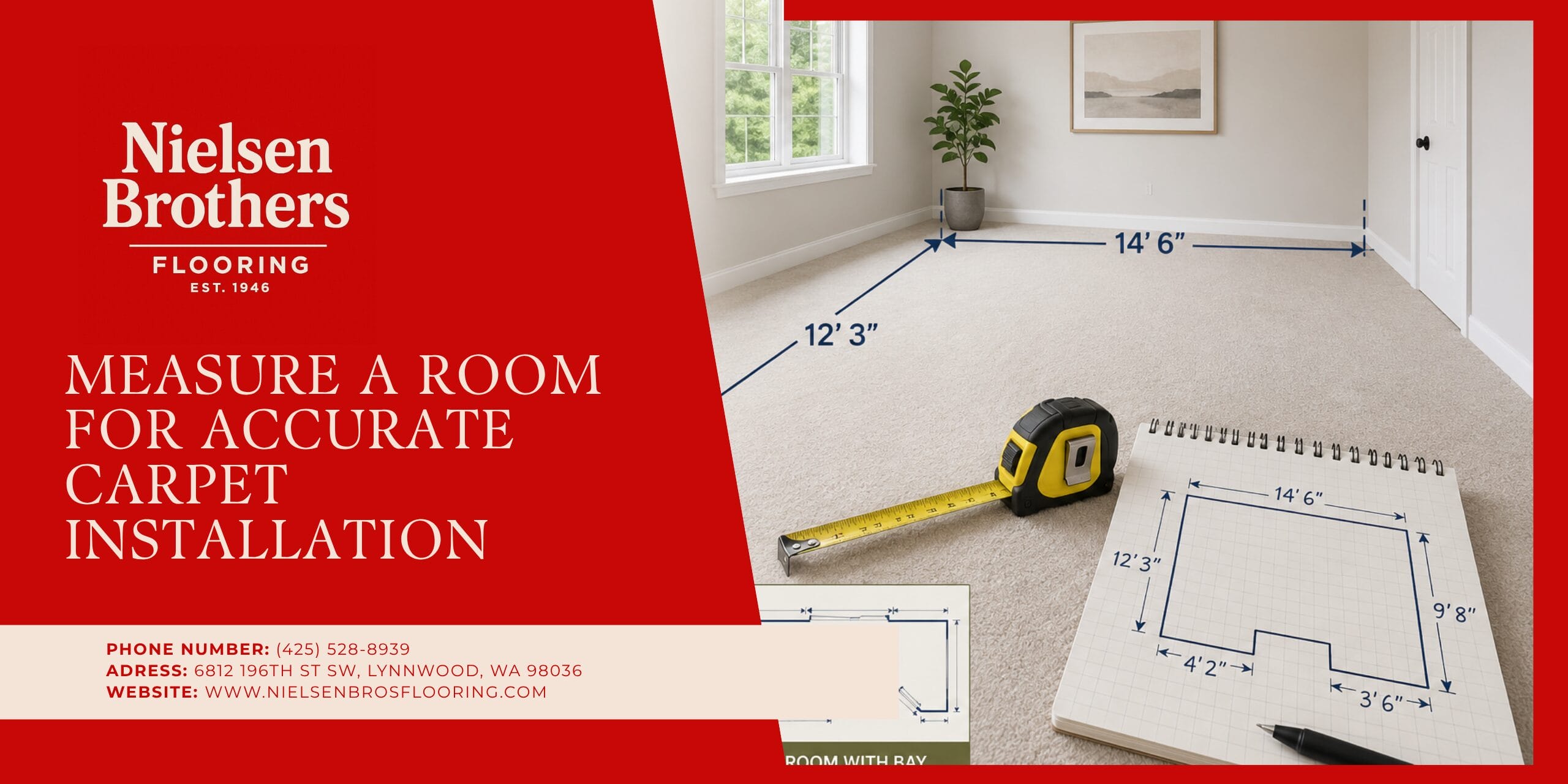
Before measuring anything, sketch the room on graph paper. Include the room shape, location of doorways, closets, bay windows, fireplaces, and any built-ins. The sketch does not need to be to scale, but the geometry should be roughly accurate. This step is the one most homeowners skip, and it is the one that prevents the most measurement errors. The sketch forces you to think about the room as a complete space rather than just length and width. Sections that need to be measured separately become visible during sketching, which prevents the most common error of forgetting irregular spaces during measurement.
As an example, consider a typical Lynnwood family room with an L shape created by a dining nook extension. Sketching the room reveals two rectangular sections that need separate measurement. A measurement that only captures the main rectangle misses the dining nook entirely and produces a material order that comes up significantly short. Sketching first catches this before measurement begins.
Measure the length and width of each rectangular section
For each rectangular section identified in your sketch, measure the length and width separately. Length is the longer dimension by convention, width is the shorter. Take measurements wall to wall at the widest points, since walls are rarely perfectly straight and the variation matters for accurate calculation. Record measurements in feet and inches rather than rounding, because the inches matter when they accumulate across multiple sections.
Take measurements at floor level rather than at the height of baseboards or trim. The carpet installation goes against the floor, not against the trim. Press the tape measure firmly against the wall to eliminate any gap that would inflate the measurement. For long spans, have your helper hold the tape at one end so the measurement remains taut and accurate.
Record every measurement on your sketch immediately rather than trying to remember multiple measurements. The discipline of writing measurements as you take them prevents the most common error of misremembering numbers when you start calculations later. Use a simple format like 14 feet 6 inches rather than decimal notation, since this matches how tape measures display measurements.
Include every closet, entry, and irregular section
Closets are the single most commonly forgotten space in DIY measurements. Walk through the home and identify every closet that will receive new carpet. Measure each one separately. Bedroom closets, hallway closets, linen closets, walk in closets, and pantry closets if they are being carpeted all need to be included. A typical home has 4 to 8 closets, and forgetting them produces measurement shortages that range from 20 to 100 square feet depending on closet sizes.
Entries and transition areas between rooms require attention as well. A hallway carpet installation includes the actual hallway plus any small entry alcoves at the ends. The transition area where carpet meets hardwood or tile needs to be measured to the precise transition line rather than estimated. Our carpet installers handle these transition measurements precisely because the difference of even a few inches affects both material quantity and transition strip selection.
Irregular sections like bay windows, alcoves, fireplace hearths, built in cabinets, and angled walls each need separate measurement. For these, measure the maximum length and maximum width of the irregular space, then note the actual shape on your sketch. Professional carpet installers can work from these dimensions plus the sketch to calculate accurate material needs. DIY measurements that just give length and width without sketching produce material orders that miss the actual room geometry.
Calculate square footage section by section
With measurements complete, calculate the square footage for each section separately. Length times width gives the square footage of a rectangular section. For a 12 foot by 14 foot section, the calculation is 12 times 14 equals 168 square feet. Convert any inches to decimal feet for the calculation. A 12 foot 6 inch by 14 foot 3 inch section is 12.5 times 14.25 equals 178 square feet.
Add the square footage of all sections together to get the total for the room or installation area. For a master bedroom with a 200 square foot main area and a 30 square foot walk in closet, the total is 230 square feet. Track these calculations on the same sheet as your sketch so the numbers and the room geometry stay connected.
Convert to square yards and add the waste factor
Carpet sells in square yards, so convert your square footage total by dividing by 9. The 230 square foot bedroom example converts to 230 divided by 9 equals 25.56 square yards. Round up to the next whole square yard for ordering purposes, which gives you 26 square yards before waste factor.
Add the appropriate waste factor based on room shape and carpet type. Rectangular rooms with standard carpet typically need 10 to 12 percent waste, which means multiplying the square yards by 1.10 or 1.12. The 26 square yard bedroom becomes 28.6 or 29.1 square yards with waste factor, rounded up to 30 square yards for ordering. Irregular shaped rooms need 15 to 20 percent waste. Patterned carpet that requires pattern matching needs 20 to 25 percent waste. Stairs need additional waste depending on installation method and carpet style.
Why Waste Factors Matter More Than They Seem
The waste factor in carpet measurement is not optional padding or sales pressure to buy extra material. It reflects the physical reality of how carpet rolls work and how installations actually proceed. Understanding the underlying reasons helps homeowners appreciate why professional measurement matters and why DIY attempts to skip waste factors create problems.
Carpet rolls come in 12 foot widths from virtually all manufacturers. This means any room wider than 12 feet requires either seaming pieces together or accepting waste from cutting roll widths that exceed room dimensions. A 15 foot wide room receives carpet cut from a 12 foot roll plus an additional 3 foot strip, which means at least 25 percent of one cut becomes waste. The waste factor in measurement accounts for this physical reality, and proper carpet fitting during installation handles the placement of these cuts to minimize visible seams in the finished room.
Pattern matching adds substantially to waste requirements. Patterned carpet, whether stripes, designs, or any visible repeating pattern, must align across seams to look right. The pattern repeat distance determines how much material gets used for alignment versus actual coverage. Pattern repeats of 12 inches or more can push waste factors above 25 percent for the same square footage of finished installation.
Installation accommodation requires additional material for stretching, trimming at walls, and connecting to transition strips. Even perfectly rectangular rooms with solid color carpet need 8 to 12 percent waste to accommodate these installation requirements. The waste factor is not generous, it is realistic.
Future repair availability is the often forgotten reason waste factors matter. If you measure exactly the calculated square footage with no waste factor and an installation problem occurs, you have no extra material for repairs. The same applies if a stain develops later that requires patching, or if you decide to extend the installation to an adjacent room next year. Quality carpet installation services typically suggest keeping a small remnant from each installation specifically for these future repair scenarios. The waste factor builds in this future repair availability.
Special Considerations for Specific Situations
Standard rectangular rooms with solid color carpet represent the easy end of carpet measurement. Many real installation projects involve complications that require additional consideration.
Stair installations
Stairs are genuinely the most complex part of any carpet installation, both for measurement and for the actual installation work. Each tread, riser, and stringer needs measurement. The carpet style affects how it wraps around the nose of each tread, which determines material requirements. Different installation methods produce different waste patterns. The accumulated complexity is why the Nielsen Brothers team specifically recommends professional measurement for any project involving stairs, regardless of how comfortable the homeowner is with measurement of flat rooms.
For rough planning purposes, a typical residential stair installation requires approximately 1 linear yard of carpet per stair. A 13 step staircase needs roughly 13 linear yards, which translates to a specific square yardage based on the width of the staircase. This estimate is useful for budgeting conversations but not accurate enough for actual material ordering, which is why professional measurement matters for stairs.
Patterned and bordered carpets
Patterned carpets require pattern matching at seams, which substantially increases waste factor requirements. Our Lynwood certified flooring installers account for the specific pattern repeat distance of your selected carpet during measurement, which sometimes affects the final product recommendation when patterns are particularly challenging. Bordered carpets that combine field carpet with border accents require even more sophisticated measurement planning. Both situations consistently produce DIY measurement errors when homeowners attempt them without professional support.
Open floor plan transitions
Many modern Lynnwood homes have open floor plans where carpet meets hard surface flooring across long transitions. These transitions need precise measurement because both the carpet edge and the transition strip selection depend on the exact location. Open floor plans also affect seam planning, since seams that work fine in closed rooms become more visible when sight lines extend across multiple spaces. The Nielsen Brothers carpet installers handle these open plan considerations during measurement and consultation specifically to avoid problems during installation.
Pet zones and high traffic patterns
Carpet measurement intersects with product selection in ways that affect material orders. Homes with active pets or specific high traffic patterns sometimes benefit from carpet selections with built in stain resistance or specific construction features. These product selections may have different roll widths or pattern requirements than standard products, which affects the measurement calculations and waste factors. Nielsen Brothers Flooring Installers discusses these factors during the measurement appointment to ensure the material order matches both the room dimensions and the product selection appropriately.
Multi room and whole house installations
Installing carpet across multiple rooms simultaneously affects measurement and ordering decisions that single room installations do not face. Roll efficiency improves substantially when multiple rooms can draw from the same roll, which can reduce overall material requirements compared to ordering for each room independently. The Nielsen Brothers measurement process accounts for these efficiency gains across whole home projects, which sometimes reduces material costs noticeably compared to single room calculations summed together.
Practical Examples from Nielsen Brothers Lynnwood Projects
The principles described above become clearer with specific examples drawn from actual Lynnwood carpet installation projects. These examples illustrate how the measurement process works in real homes.
Example 1: Master bedroom with walk in closet
A typical Lynnwood master bedroom measures 14 feet by 16 feet, which produces 224 square feet for the main room. The walk in closet measures 6 feet by 8 feet for an additional 48 square feet. Total area is 272 square feet, which converts to 30.2 square yards. With a 12 percent waste factor for the rectangular geometry and solid color carpet, the order becomes 33.8 square yards, rounded up to 34 square yards for ordering. The carpet installers from Nielsen Brothers Flooring verify these measurements during the in home assessment and confirm the order quantity before purchase.
Example 2: Family room with dining nook
A family room with an L shaped layout creates measurement complexity. The main rectangle measures 18 feet by 20 feet for 360 square feet. The dining nook extension adds a 6 foot by 10 foot section for 60 square feet. Total area is 420 square feet, which converts to 46.7 square yards. The L shape increases the waste factor to 15 percent because of cutting patterns required for the irregular geometry. Final order becomes 53.7 square yards, rounded up to 54 square yards. Our team plans seam placement during the measurement consultation to ensure the L shape transition looks clean in the finished installation.
Example 3: Whole second floor with stairs
A whole second floor installation including three bedrooms, hallway, and the stairs leading up presents the most complex measurement scenario. Three bedrooms total 580 square feet. The hallway adds 75 square feet. Stairs require separate stair specific calculation, typically 12 to 15 linear yards depending on width and step count. Total square yardage runs 80 to 95 depending on stair specifics, with waste factors averaging 14 percent across the various spaces. The Nielsen Brothers measurement appointment for this scope typically takes 60 to 75 minutes and produces material orders accurate to within a few square yards of actual installation requirements.
Example 4: Bedroom with bay window
A bedroom with a bay window requires the irregular section approach. The main rectangle measures 12 feet by 14 feet for 168 square feet. The bay window creates an angled extension that measures approximately 3 feet deep across an 8 foot width, but the angles mean the actual area is about 19 square feet rather than the 24 square feet a rectangular calculation would suggest. Total area is 187 square feet, which converts to 20.8 square yards. The irregular bay shape increases waste factor to 16 percent, producing a 24.1 square yard order rounded to 25 square yards. The bay window section installation requires specific technique that the Nielsen Brothers carpet installers handle as part of standard flooring service.
Why Professional Measurement Matters for Your Project
The DIY measurement process described in this guide produces useful preliminary numbers that help with budgeting and planning conversations. For actual material ordering and installation, professional flooring measurement remains the right approach for several specific reasons that the Nielsen Brothers team encounters regularly.
Measurement verification catches errors that homeowners cannot easily detect. A measurement that seems straightforward sometimes contains errors of 6 inches or more because walls are not perfectly straight, corners are not perfectly square, or sections were missed during the initial measurement pass. Professional carpet installers verify measurements during the in home assessment with calibrated tools and the trained eye for measurement situations that frequently produce errors. The verification costs nothing as part of standard consultation but prevents the cost of material shortages or excess orders.
Product specific waste factors require professional knowledge that DIY guides cannot fully convey. Different carpet products from different manufacturers have different roll widths, pattern repeats, and installation characteristics that affect waste calculations. The 12 percent waste factor that works fine for one product might be inadequate for another. The Nielsen Brothers team knows these product specific factors from working with the actual products being considered for your project, which produces material orders matched to the specific carpet you are buying rather than generic estimates.
Seam planning happens during measurement rather than during installation. Where seams fall in the finished room affects appearance, durability, and how the room reads visually. Professional measurement includes deliberate seam placement planning that considers traffic patterns, light direction, and room geometry. DIY measurements that focus only on square footage miss the seam planning component that distinguishes excellent installations from acceptable ones.
Subfloor and transition assessment happens during the measurement visit. The Nielsen Brothers measurement appointment includes evaluation of subfloor condition, transition details to other flooring, and any preparation work that affects the project timeline and cost. These factors do not affect carpet measurement directly but affect overall project planning in ways that DIY measurement alone cannot address.
Accountability shifts to the team that produced the measurements. When the Nielsen Brothers carpet installers measure your project and produce the material order, any measurement errors become our responsibility rather than yours. This accountability matters because measurement errors are expensive to correct after material has been ordered or installation has begun. The protection of professional accountability often justifies the time involved in scheduling a measurement appointment even when the homeowner is comfortable with DIY measurement.
How the Nielsen Brothers Measurement Process Works
The Nielsen Brothers Flooring measurement appointment is structured to produce accurate measurements while also serving as the consultation that informs your carpet selection and project planning. The visit typically takes 30 to 90 minutes depending on project scope and produces both immediate measurements and useful guidance on product selection.
Scheduling the appointment is straightforward. Contact the Nielsen Brothers team to arrange a time that works for your schedule, including evenings and weekends when available. The team brings measuring tools, sample materials based on initial phone conversation about your project, and the experience that lets us answer questions about carpet options as they come up during the visit.
During the visit, our carpet installers measure each space being carpeted with calibrated tools, document the measurements and room sketches in our system, identify any subfloor or transition considerations, and discuss carpet options appropriate for each space. The conversation covers traffic patterns, household composition including pets and children, style preferences, budget considerations, and any specific concerns. Sample materials in hand make this conversation substantially more productive than abstract discussion of options without physical reference.
After the visit, you receive a detailed quote based on the actual measurements and your discussed product preferences. The quote itemizes carpet, padding, removal of existing flooring if applicable, installation labor, transitions, and any subfloor work. Pricing is transparent rather than presented as a single number that requires faith to evaluate. The Nielsen Brothers carpet installation services include warranty terms documented in writing rather than as verbal commitments.
If you decide to proceed, installation scheduling typically follows within 2 to 4 weeks depending on material lead times and current crew availability. The same measurement that produced the quote drives the actual material order, which eliminates the gap between what you were quoted and what gets ordered for your project. Our carpet installers handle the work using the measurements taken during your consultation, which produces the matching between quote and installation that DIY measurement workflows often lack.
We believe in educating our customers so that they can reach a decision after knowing everything about flooring. Check out our flooring guides curated with our 80 years of experience:
Schedule a Measurement Appointment in Lynnwood
Nielsen Brothers Flooring serves Lynnwood and the surrounding Snohomish County communities with carpet installation services across residential and commercial flooring projects. Our local Lynnwood flooring experts understand the housing variation across the Lynnwood area, from older neighborhoods with original features to newer suburban construction, and bring appropriate expertise to projects in each housing type.
Contact Nielsen Brothers Flooring to schedule a measurement appointment for your Lynnwood carpet installation project. The appointment costs nothing and produces useful information whether or not you ultimately work with our team. Bringing photos of your rooms, rough notes on which spaces you want carpeted, and any specific concerns helps the measurement consultation move efficiently and produce the most useful guidance for your decision making.
Whether you are planning a single room carpet replacement, a whole home flooring update, or a commercial carpet installation project in the Lynnwood area, the Nielsen Brothers team is set up to handle the measurement and installation through a single integrated process. The measurement is the starting point for everything else that follows, which is why we treat it as the foundation of every successful carpet installation rather than as a formality to complete before the real work begins. For homeowners searching for local carpet installers or a carpet installation company that handles the complete project from measurement through final cleanup, the Nielsen Brothers team brings the integrated approach that produces consistently good outcomes.
Frequently Asked Questions
Why does my carpet measurement need to include extra material
Carpet comes in rolls that are 12 feet wide, which means most rooms require seaming or material waste to accommodate the roll width. Standard waste factors run 10 to 15 percent for typical rectangular rooms, increasing to 20 percent or more for complex room shapes, patterned carpet requiring pattern matching, or stairs. The Nielsen Brothers measurement team accounts for these factors automatically based on your specific room and product selection. Skipping the waste factor produces installations that come up short of material, which delays projects and creates problems matching additional material later.
How accurate does a DIY carpet measurement need to be
DIY measurements need to be accurate within about 1 inch on each dimension to avoid material problems. Errors of 6 inches or more in length or width can produce material shortages or significant cost overruns. The Nielsen Brothers carpet installers verify measurements during the in-home assessment regardless of what DIY measurements you provide, because the cost of measurement errors falls on the project rather than on the homeowner who provided the measurements. Professional measurement is included with our carpet installation services for this reason.
Can I measure stairs myself or do I need a carpet installer
Stair measurement is genuinely difficult and one of the situations where the Nielsen Brothers team strongly recommends professional measurement. Each tread, riser, and stringer needs precise measurement, the carpet style affects how the material wraps, and stair installations have specific patterns of waste that vary by approach. Amateur stair measurements produce material shortages or excess waste more often than not. Our residential carpet installation team handles stair measurement as part of standard project assessment.
What is the difference between square feet and square yards for carpet
Carpet has historically been sold in square yards, though many flooring retailers now price in square feet for consumer comparison. One square yard equals 9 square feet. A 200 square foot room equals approximately 22 square yards. The Nielsen Brothers team works in both units depending on customer preference, but the underlying calculations and product sourcing happen in square yards because that is how carpet manufacturers measure and sell the product. Confirm which unit your quotes use to avoid confusion when comparing options.
Do I include closets and entries when measuring for carpet
Yes, every space being carpeted needs to be included in the total measurement. Closets are commonly forgotten in DIY measurements, which produces material shortages once the project begins. Entries, hallway transitions, and spaces under built in furniture all factor into total square footage. The Nielsen Brothers measurement process covers every space that will receive new carpet, which is one reason our quotes match actual project requirements rather than producing surprises during installation.
How does Nielsen Brothers handle measurement for irregular rooms
Irregular shaped rooms get measured by dividing them into rectangular sections, measuring each section separately, and combining the totals with appropriate waste factors. Bay windows, angled walls, alcoves, and other irregularities each add measurement complexity that DIY approaches often handle poorly. Our carpet installers are trained specifically in measuring irregular spaces and producing accurate material orders that account for the additional waste these shapes typically require.
Will my carpet have visible seams after installation
Carpet wider than 12 feet requires seams, and where those seams fall depends on measurement and planning during installation. Skilled carpet installation services place seams in low traffic areas perpendicular to incoming light to make them as invisible as possible. The Nielsen Brothers team discusses seam placement during the measurement and consultation phase rather than handling it as an installation day detail. Seams in solid color carpet from quality manufacturers properly installed are essentially invisible in the finished room.
How long does professional measurement take
A typical Nielsen Brothers in home measurement takes 30 to 90 minutes depending on the project scope. Single room measurements often finish in 30 to 45 minutes. Whole home measurements with multiple rooms and stairs take longer. The visit covers actual measurement, discussion of carpet options appropriate for each space, identification of any subfloor or transition considerations, and time for your questions. The measurement appointment costs nothing as part of our consultation process for carpet installation projects.
What should I do before the Nielsen Brothers team arrives to measure
Clear access to the rooms being measured, including moving items away from walls where measurements will be taken. Have rough notes on which rooms get carpet and which keep their existing flooring. Think about questions for the consultation, including style preferences, traffic patterns, and any specific concerns. Pets in a separate area during the measurement helps the team work efficiently. The visit produces both accurate measurements and useful guidance on product selection, so being prepared to discuss your project gets the most value from the appointment.